
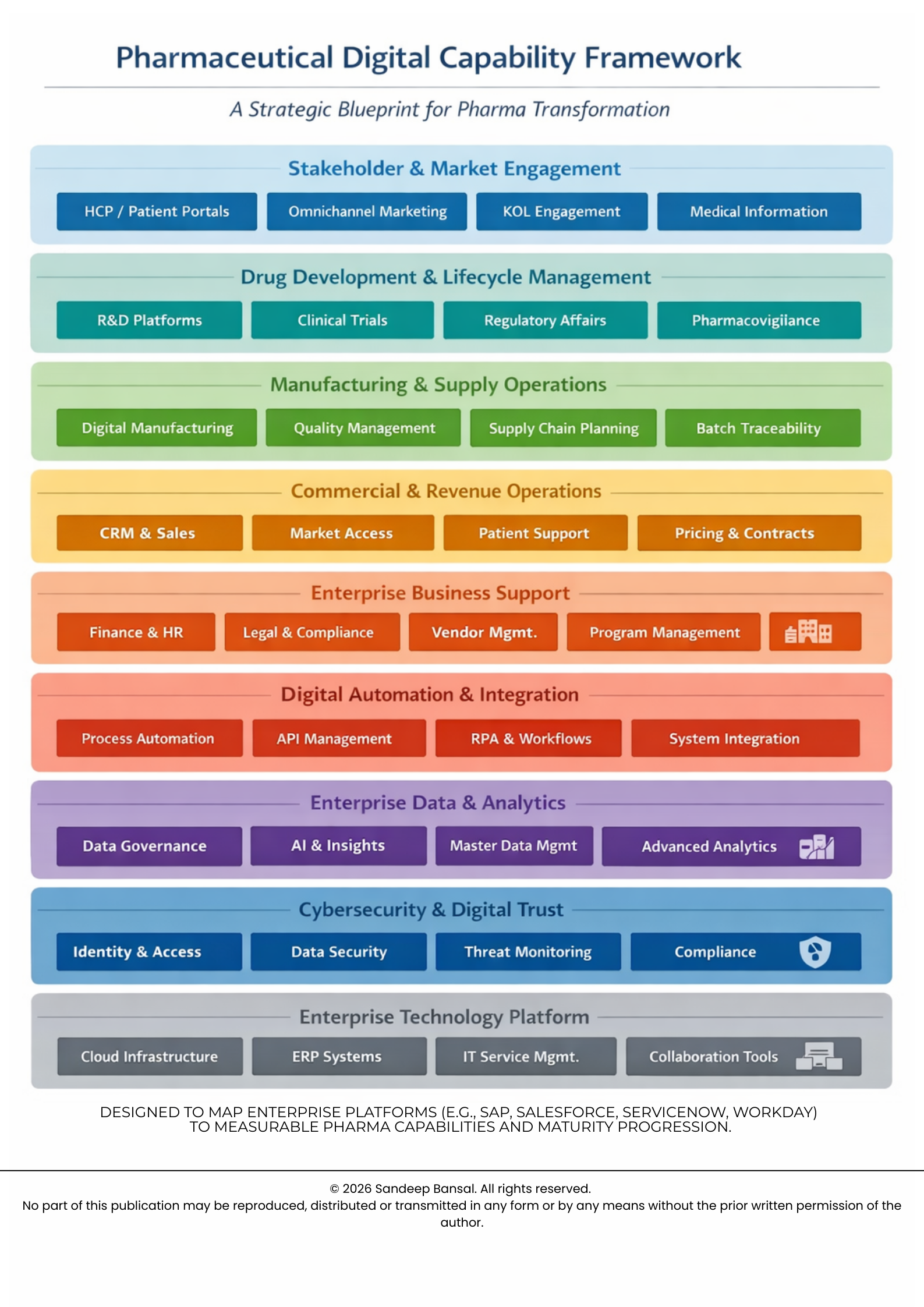


Pharmaceutical companies are investing billions in digital transformation.
Cloud migration. AI-powered drug discovery. AdvancedAutomation in manufacturing. data platforms.
Yet despite massive technology investments, many transformation programs struggle to deliver measurable business outcomes.
The problem is not technology.
The problem is architecture.
Pharma is One of the Most Complex Enterprises on Earth
Unlike most industries, pharmaceutical companies operate across a multi-layered value chain:
- Drug discovery and research
- Clinical trials and patient data management
- Regulatory submissions and compliance
- Manufacturing and quality control
- Global supply chain distribution
- Commercial engagement with healthcare providers
Each layer runs on specialized systems, compliance frameworks, and regulatory controls.
When transformation initiatives happen in silos, organizations end up modernizing technology without modernizing the enterprise capabilities behind it.
The Cost of Capability Blind Spots
According to industry studies:
- Large pharma companies operate over 1,000 enterprise applications across R&D, manufacturing, and commercial operations
- Nearly 60% of digital transformation initiatives fail to achieve expected ROI due to fragmented enterprise architecture
- CIOs spend 70–80% of IT budgets maintaining legacy systems
This creates a familiar pattern:
New digital tools are added, but the core enterprise capabilities remain disconnected.
The Role of Capability Architecture
This is where enterprise capability frameworks become powerful.
Instead of thinking about transformation as a collection of technology projects, organizations map the core capabilities required to run the pharmaceutical enterprise.
These capabilities typically span areas such as:
- Research and drug discovery
- Clinical development
- Regulatory management
- Manufacturing operations
- Quality and compliance
- Supply chain and logistics
- Commercial engagement
- Data governance
- Cybersecurity and risk management
When these capabilities are architected together, technology decisions become strategic enablers rather than isolated upgrades.
The Strategic Shift for Pharma CIOs
The role of the CIO is evolving from technology operator to enterprise architect.
Modern CIOs are now responsible for designing capability-driven digital enterprises where:
Technology investments support end-to-end value chains rather than departmental tools.
Digital transformation in pharma does not begin with technology. It begins with designing the capabilities that will power the next generation of pharmaceutical innovation.